Next Role: an AI-native career operating system, built while actually job hunting
Next Role helps a person discover, evaluate, prepare for, and apply to remote roles: tailoring their real resume and cover letter, scoring every job with honest reasoning, and preparing them for the interview, all from one place, instead of a dozen open tabs and a messy spreadsheet.
Role
Product Designer & Product Lead (solo)
Platform
Web application, responsive across desktop and tablet, real multi-device account access
Timeline
13+ sprints, continuous iterative build over several months
Team
1, directing three AI tools (Claude for planning, Claude Design for prototyping, Claude Code for implementation) through every round
Tools
Next.js, React, TypeScript, Tailwind CSS, Supabase (Postgres + Auth), Vercel, Google Gemini API, Claude / Claude Design / Claude Code
This wasn't built from formal interviews or a research study. It came from actually job hunting for remote roles myself and hitting the same wall over and over. Three gaps kept showing up:
Tailoring takes real time, every single time. The same resume needed re-tailoring for each role, cover letters written mostly from scratch, with no honest way to know beforehand whether a job was actually worth that time.
AI writing tools can't be trusted blindly. Every AI resume tool I'd tried had the same underlying risk: I could never tell if it was quietly inventing a skill or an accomplishment I didn't actually have, which is a real, serious risk in an actual interview.
The whole search lives in fragments. Job boards, saved links, a resume folder, application statuses. Nothing tied the search together into one place I could trust.
Applying widely while managing real financial pressure, with no recruiter or career coach helping filter what's actually worth pursuing.
Goals
Apply to genuinely good-fit remote roles efficiently, without spending hours re-tailoring the same resume for jobs that turn out not to be worth it.
Frustrations
Generic AI resume tools feel untrustworthy, with no way to know if they're quietly overselling real experience. Job boards are scattered, and nothing tracks the whole search in one place.
Behavior
Keeps a messy personal spreadsheet of applications, manually rewrites the same resume section over and over, dreads interview prep because there's no real way to rehearse.
What would change that
A tool that tells the truth about fit before investing the time, prepares real materials automatically once a job is worth it, and never pretends a weak match is a strong one.
03User stories
As a job seeker with limited time, I want the AI to score how well a job actually fits me with real reasoning, so I only invest tailoring time in roles genuinely worth pursuing.
As someone relying on an AI tool for my resume, I want every generated document to only reflect experience I actually have, so nothing I submit could embarrass me in a real interview.
As the final decision-maker in my own search, I want to explicitly approve, reject, or hold every AI recommendation, so nothing is sent on my behalf without my say.
As someone preparing for a real interview, I want honest coaching that tells me plainly when my own background doesn't cover a likely question, instead of a script I can't actually deliver.
As someone managing a search with a tight budget, I want the AI cost of running my search to be something I can actually see and control.
As someone applying from more than one device, I want my real search, saved jobs, and applications to be the same whether I'm on my laptop or my tablet.
04Exploring the shape of the product
Early visual direction: the teal/seafoam identity and warm-neutral palette established before any screen was built.
05User flow
The real Core Workflow:
Career Memory
Campaign
Job Discovery
AI Match
Decision Center
Resume Tailoring & Cover Letter
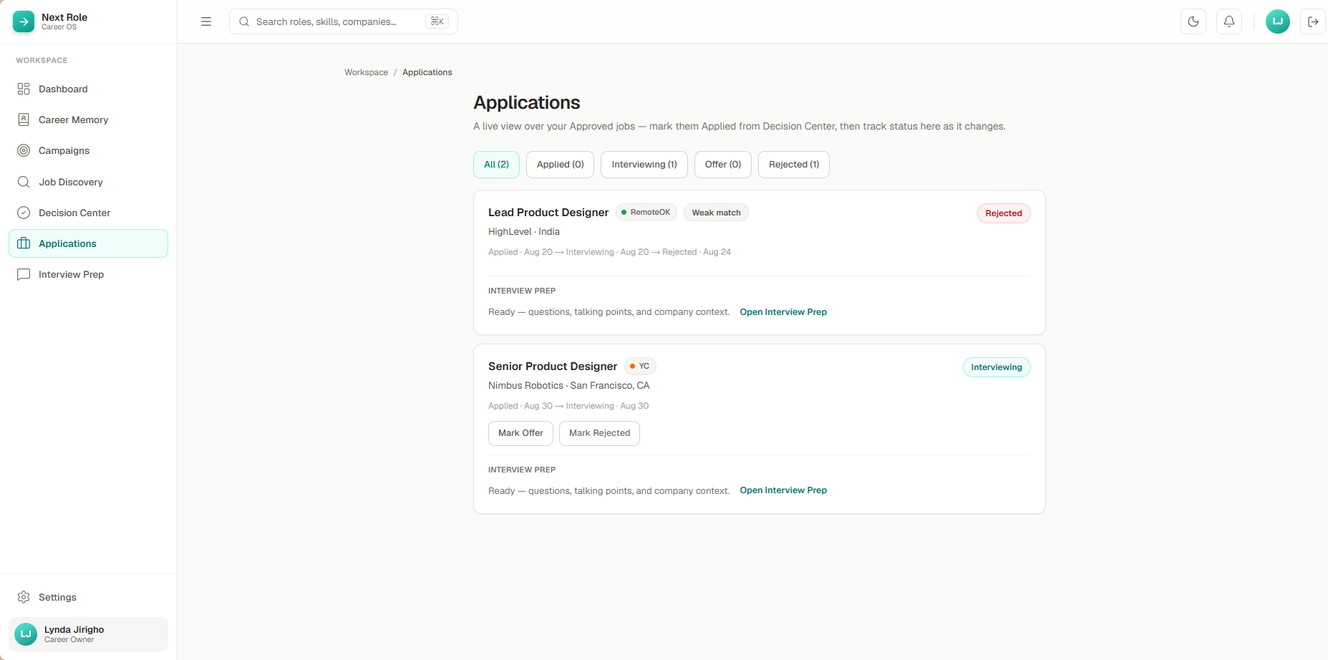
Application Tracker
Interview Prep & Practice
Outcome Learning
06User journey: from first open to a real application sent
Stage
Building Career Memory
First real job match
Deciding & preparing
Ready for the interview
Doing
Answers a step-by-step wizard about real background, goals, and assets
Runs a real job search, sees each job's AI match score
Approves a job, watches the real resume & cover letter generate
Reviews likely questions, practices out loud, gets honest spoken feedback
Feeling
Cautious about how the AI will use this information
Skeptical of AI scoring, having been oversold before
Anxious the AI might overstate real experience
Nervous about the interview itself, wants to feel genuinely prepared
Risk
Abandons setup if it feels like just another form
Distrusts a high score with no real explanation
Loses trust the moment anything feels exaggerated
Practice feels like empty encouragement, not real preparation
What Next Role does
Honest "not started yet" states, save-and-resume per section, no fabricated placeholder data
Every score paired with a written, evidence-based explanation, proven honest under a deliberately mismatched test case
Generated documents grounded strictly in real background, explicit "no invented skills" system constraint
Real gaps flagged plainly ("worth asking, not guessing"), honest spoken feedback instead of generic praise
07Wireframes: mid-fidelity structure
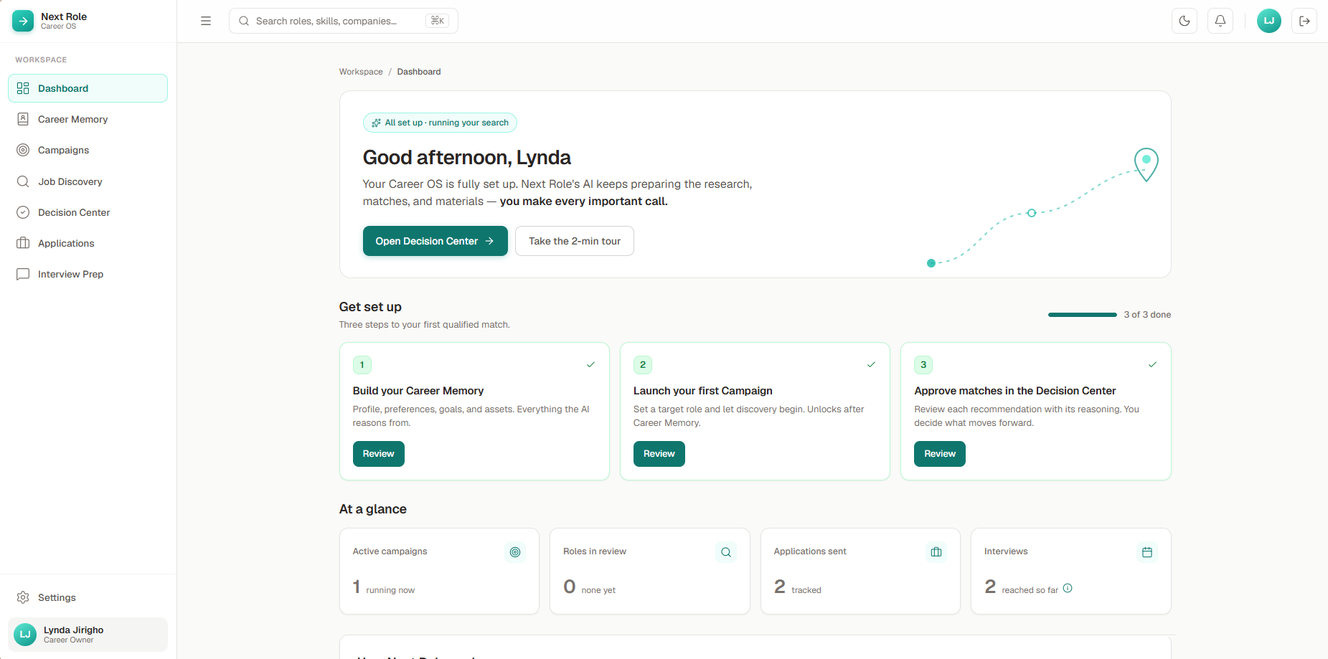
Dashboard
Top bar with search, notifications, account
Hero greeting + setup progress
Three-step "Get set up" checklist
"At a glance" stat cards (Active campaigns, Roles in review, Applications sent, Interviews)
Job Discovery
Campaign context bar
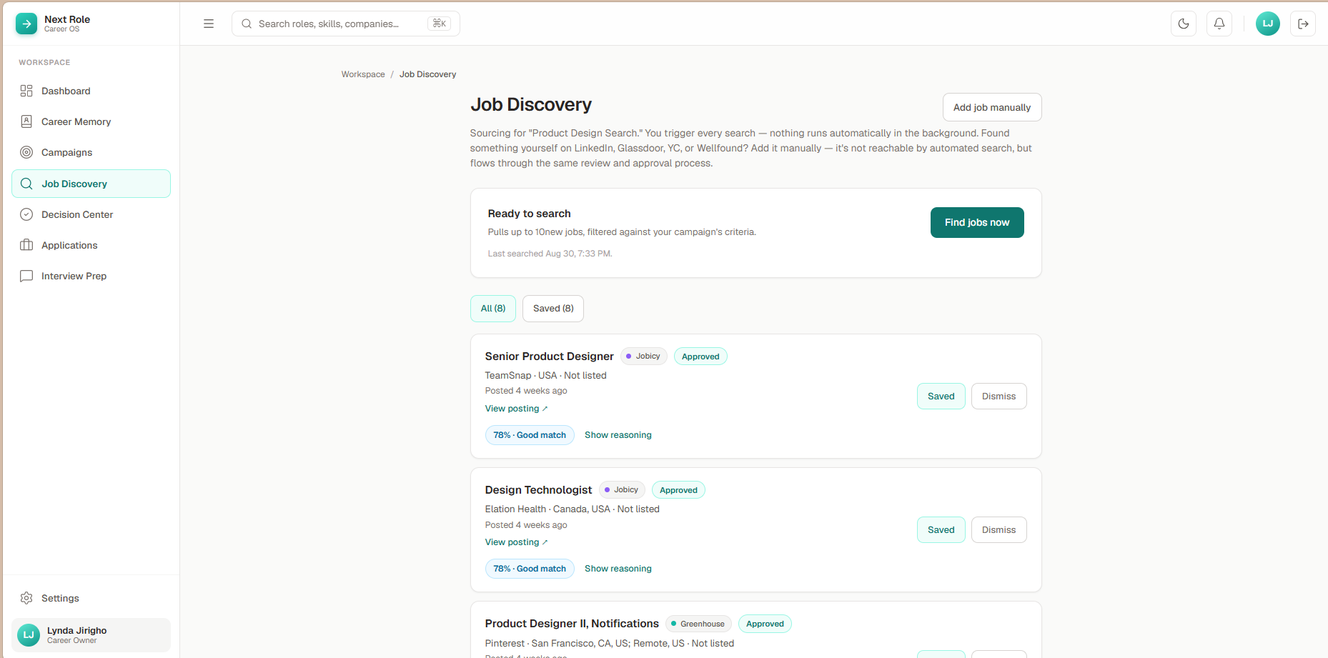
Job card list (title, company, location, salary, source badge)
Save / Dismiss controls per card
AI match badge (level + score + explanation, shown on Saved jobs)
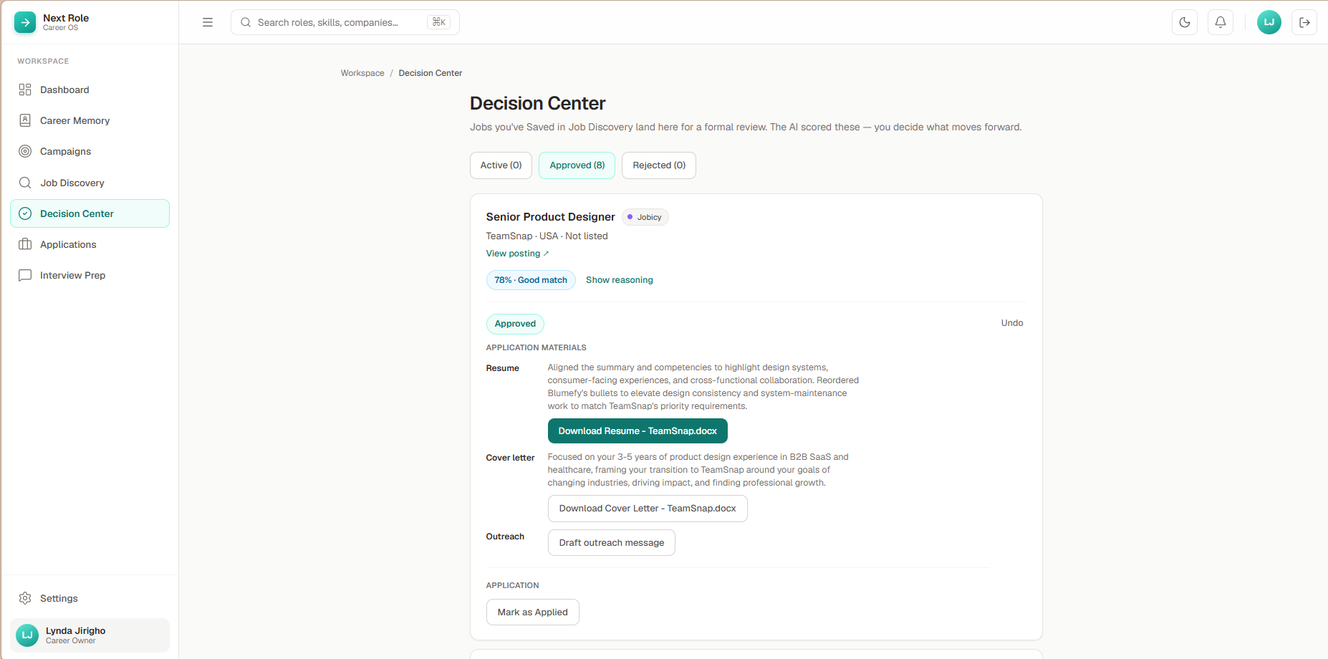
Decision Center
Active / Approved / Rejected filter chips
Job card with match reasoning
Approve / Reject / Hold controls
Application materials section (Resume / Cover Letter / Outreach status)
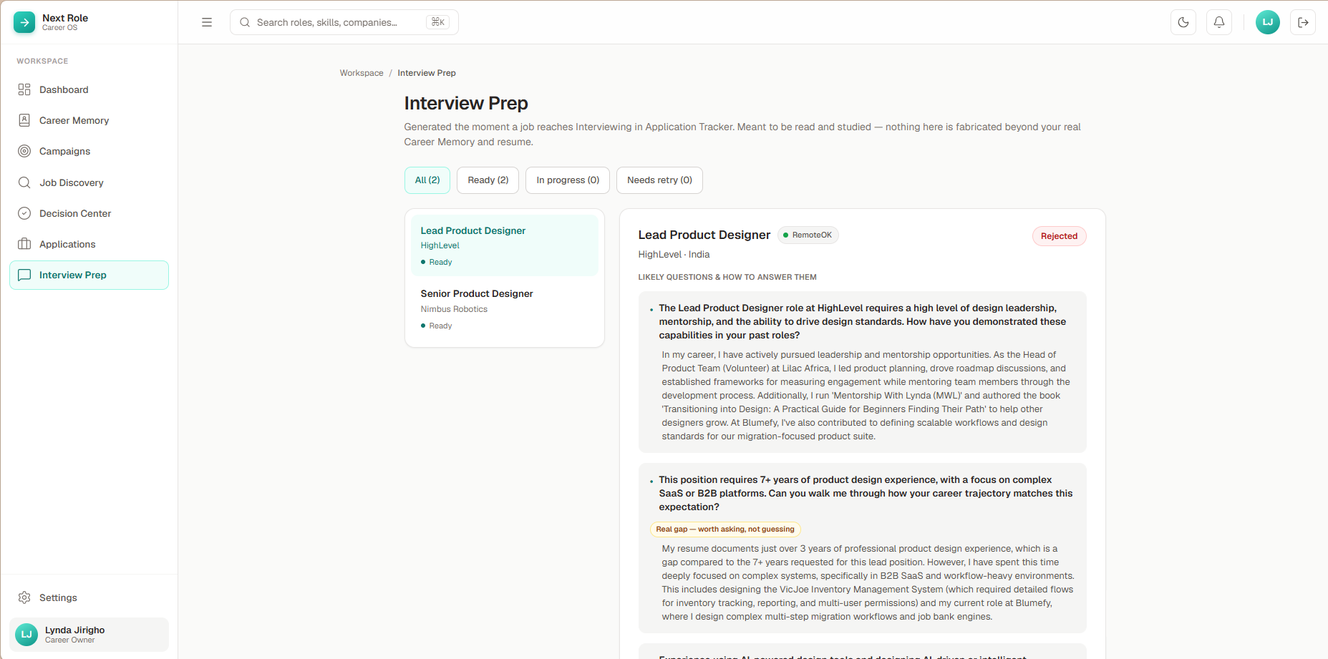
Interview Prep
Master-detail layout: compact job list + detail panel
Likely questions paired with grounded answers
Company context section
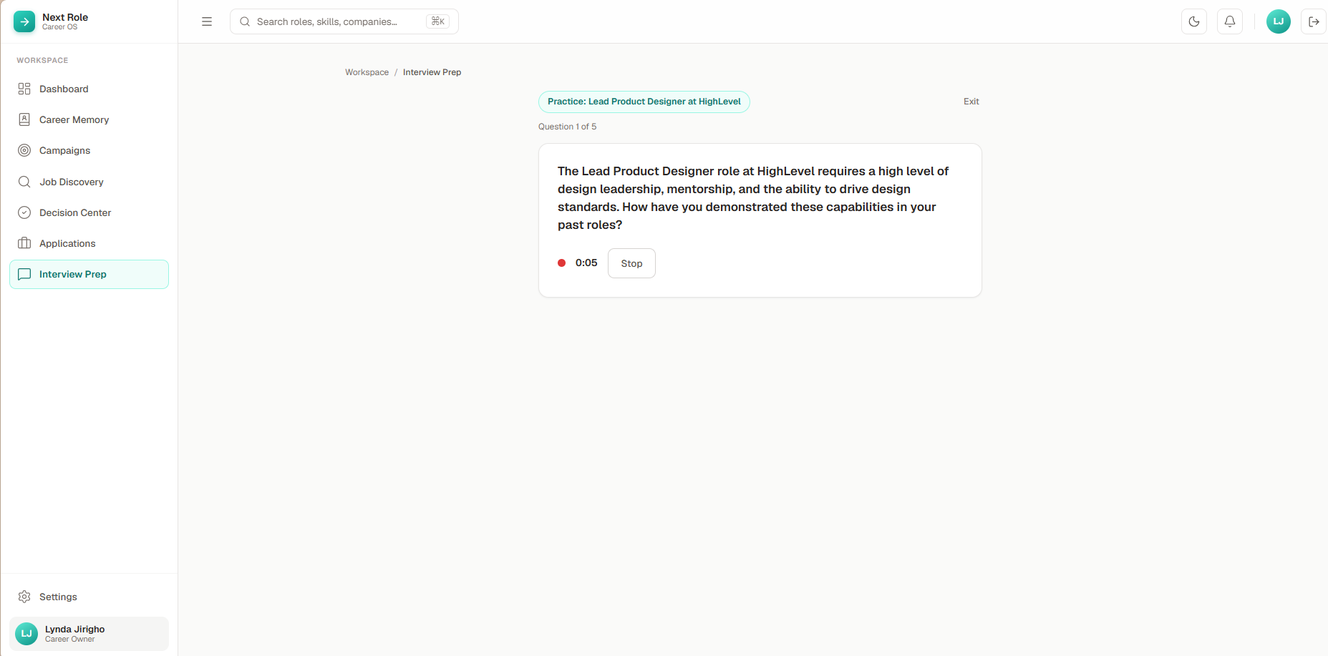
"Practice out loud" entry point
08Challenges: the AI quota crisis that led to a better architecture
Next Role was originally planned to run entirely on the Gemini free tier. That was the deliberate, budget-driven decision from the start, since I was actively job hunting with no income to spend on API costs. It didn't survive contact with real usage.
The plan: free tier, no billing, ever.Every AI feature (matching, resume tailoring, cover letters, interview prep) was scoped from day one to run on Gemini's published free-tier limits.
The blocker: the real limit was far lower than documented.Live testing against a real API key surfaced a hard cap of 20 requests per day, not the roughly 1,500/day the published documentation implied. A single day's job search could exhaust the entire budget before a resume was ever generated.
What got tried and ruled out.A third-party recommendation to spread tasks across other AI providers' free tiers was fact-checked directly rather than trusted. The specific free options recommended had already been discontinued, with real documented warnings against depending on rotating free-tier availability.
The architecture fix: score only what's actually saved.AI Matching was redesigned from "score every job discovered" to "score only jobs actively saved", cutting real usage dramatically while tying AI effort directly to genuine interest, a better product decision on its own merits, independent of the budget pressure that produced it.
The same constraint, resolved with real numbers, not guesswork.When even that wasn't enough headroom, the actual paid-tier cost was calculated from real usage patterns before deciding anything, landing at roughly $1–2/month, a small, informed trade against risking unverified behavior on an unfamiliar provider.
The free-tier path wasn't abandoned lightly. It was tested to its real, live limit first, and the fix that followed made the whole product's cost architecture more disciplined, not just cheaper.
09Iterating through real use
Screens tested and refined across thirteen-plus sprints, each round verified against real data before moving to the next.
10Testing against real devices, not a lab
There was no formal moderated study behind this either. Testing meant real accounts, real job data, real deliberate attempts to break the parts most likely to be wrong, especially anywhere two users' data could touch. That process caught the issues that actually mattered:
A database security gap, proven closed, not assumed.For every migrated module, a second real test account directly attempted to read, edit, and delete another account's data by its exact row ID. Every attempt was rejected at the database level itself, not just hidden by the interface.
A silent double-write bug, caught before it shipped in some cases, found and fixed in others.Next.js's Strict Mode double-invokes state updaters in development, so any mutation with a network write inside that updater silently fired twice once real database calls replaced instant local storage. Root-caused and fixed at the source, then applied proactively in every later module before the same bug could reappear.
A click-outside dropdown that silently failed to close.Traced to a genuinely subtle CSS cause: a position: fixed overlay trapped inside a parent's own stacking context, so it never actually covered the elements it was meant to. Fixed with a document-level listener instead of a same-context overlay, verified with real coordinate-based clicks rather than synthetic ones, which is exactly what had hidden the bug the first time.
A resume-honesty stress test, run deliberately hard.A real resume was scored against a job requiring skills the background genuinely didn't have. The AI correctly returned a weak match with the real reasons why, instead of inflating the fit to seem more useful.
11Design system
The visual identity needed to feel like a steady, reassuring companion for someone under real job-search stress, not another cold, clinical dashboard. A teal and warm-neutral palette was chosen specifically for that reason, paired with clean typography and calm, moderate rounding throughout.
Every color pairing was measured against real accessibility standards, not eyeballed. More than one button and status badge that looked fine on screen was caught and corrected after actually failing contrast requirements once tested properly. Dark mode was treated as a real, intentional design in its own right, verified at every stage, not an inverted afterthought.
12Final design
The finished product, live now and used for a real, ongoing job search.
The Dashboard
real setup progress, real "at a glance" stats wired to actual account data, not placeholder numbers.
Decision Center
every AI-scored job with its real reasoning, and the explicit human checkpoint before anything moves forward.
Interview Preparation & Practice
grounded questions and honest talking points, paired with a real voice-based practice mode and specific spoken feedback.
13What I learned
The real skill in directing AI tools isn't the prompt. It's knowing when to demand proof.A measured contrast ratio instead of a guess, a real test account trying to break into another user's data instead of assuming security worked, a deliberately unfair test case instead of an easy one.
A budget constraint produced a better architecture, not just a cheaper one.Save-gated AI Matching wasn't the first instinct, but it turned out to be the right call regardless of the cost pressure that forced it.
Honesty has to be actively tested, not assumed.The single most important requirement in this whole build, that generated content never invents a qualification, only became trustworthy once it was deliberately stress-tested against real, hard cases, more than once.
Directing three different AI tools is still a design job.Every spec, every correction, every judgment call about what "done" actually meant still had to come from me. The tools built fast, but they didn't decide what was right.
14Where it stands today
Next Role is live and genuinely in use, not a portfolio prototype sitting untouched.
13+sprints, each one designed, built, and personally verified before moving forward
12core modules, from Career Memory through Interview Practice, all real and working
Real backend migrationmodule by module, with database-level access proven, not assumed, at every stage
$0–2/monthreal running cost, by deliberate architecture choice
Real tailored resumes sent, real interview prep usedthis is the actual tool behind an actual job search
The best outcomes in this build came from testing against real use and real data, not trusting that finished-looking output meant a finished, honest feature.
More screens
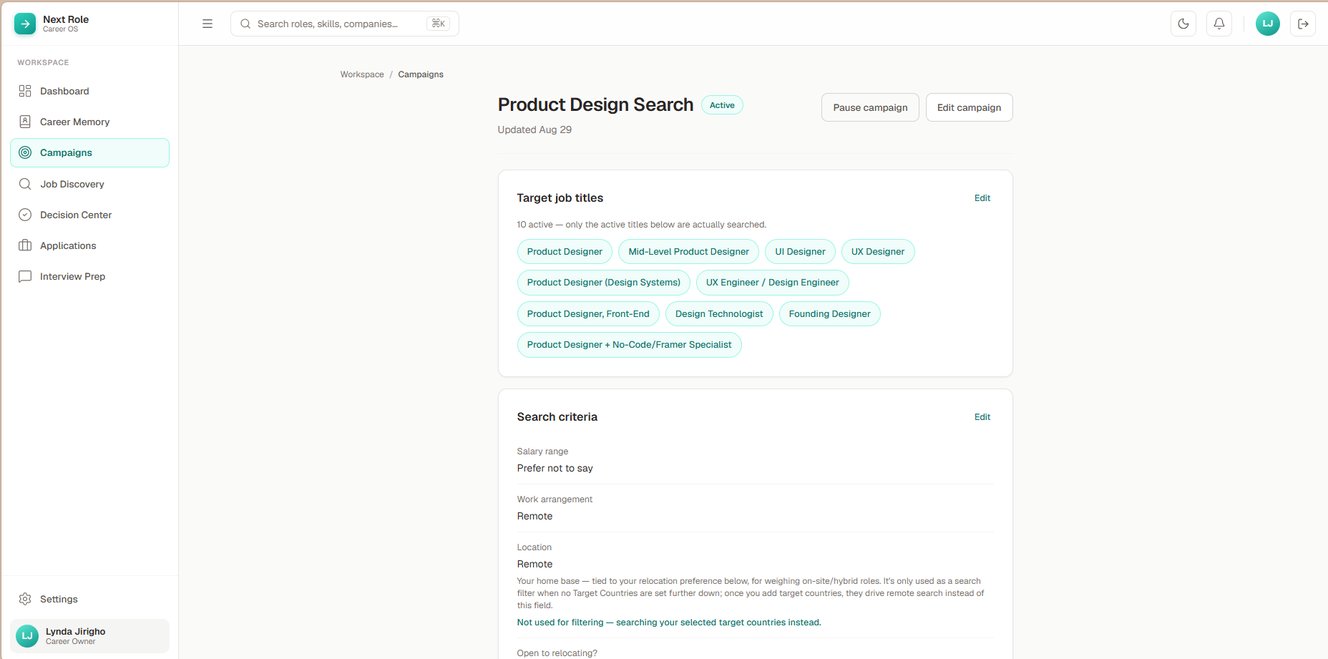
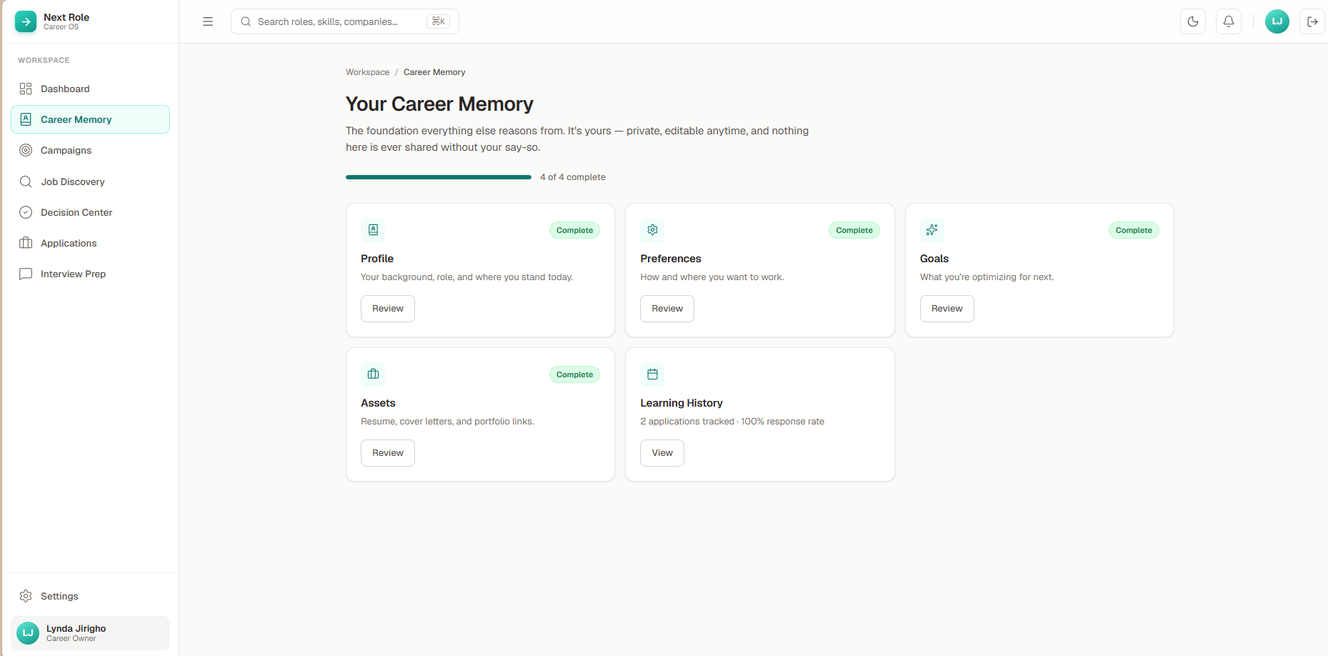
Job Discovery is the entry point of the pipeline. Six automated sources feed in here, alongside anything added manually.Campaigns: 10 active title variants, drawn from the saved pool.Career Memory feeds every stage. I caught this one myself: industry was single-select, which quietly undersold my own cross-industry background in every match score.Applications: status tracked from Applied through to outcome.