ForgeTask: turning weekly goals into daily progress
ForgeTask is a task and habit-tracking PWA that connects weekly goals to the daily work that actually builds them, with a social layer built to keep people coming back past day one.
Progressive Web App, installable on iOS & Android, no App Store
Timeline
Sept 2026, continuous iterative build
Team
1, directing an AI coding agent through every round
Tools
Expo, Supabase, Netlify, Claude Code
Live
Sept 2026
ForgeTask started from a personal gap: a weekly goal and the daily tasks meant to build it almost always live in different places, with nothing forcing them to connect. I designed and directed the build of a product where a goal is only ever made of real, linked, completed days, and paired it with a social layer (friends, shared goals, and streaks) built to make consistency feel like it matters to someone else too, not just to a private counter no one else sees.
Process: Problem framing → Spec & build → Live verification → Real-world testing
01Understanding the problem
This wasn't built from formal interviews or a research study. It came from using existing task and habit apps myself and noticing exactly where they broke down. Two gaps kept showing up:
Goals and daily action live apart. A weekly goal is a title you set once. The tasks that actually build it sit in a separate list, with nothing forcing the two to connect.
Consistency is a solo effort. Most trackers are private by design, so they're easy to abandon quietly because no one else can see the gap, and nothing costs you for skipping a day.
Balancing a day job with personal goals she's pursuing on her own time, no manager or coach checking in on either.
Goals
Make consistent progress on things that matter to her outside work, without a formal structure forcing it.
Frustrations
Goals she sets alone rarely survive a busy week. Existing trackers feel like a private to-do list no one else will ever see.
Behavior
Downloads a new productivity app every few months, uses it hard for a week, then quietly stops.
What would change that
Seeing a goal actually move because of what she did today, and a friend who'd notice if she went quiet.
03User stories
As someone setting a goal, I want to break it into daily tasks that link back to it, so my daily effort visibly moves something real forward.
As someone with an inconsistent schedule, I want a streak that reflects what I actually did, so missing one day doesn't unfairly erase everything before it.
As a friend of another user, I want to see their week and nudge or cheer them, so accountability doesn't depend on remembering to check in manually.
As two friends working toward the same thing, I want a shared goal that combines both our progress, so we're building one result together, not two separate ones.
As a new visitor, I want onboarding to explain the app once and never force itself on me again, so opening the app the second time feels immediate, not repetitive.
As someone trying this out casually, I want to install it like a real app without an App Store, so trying it costs me nothing and takes one tap.
04Exploring the shape of the product
Alongside the wireframes, the product was shaped directly against real, running screens: specifying an interaction, seeing it built, then refining it against what actually rendered.
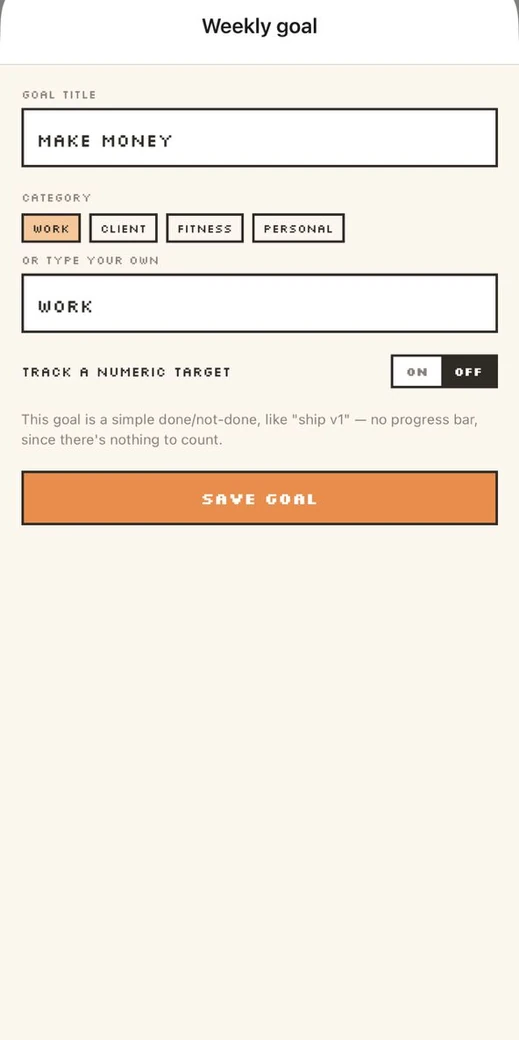
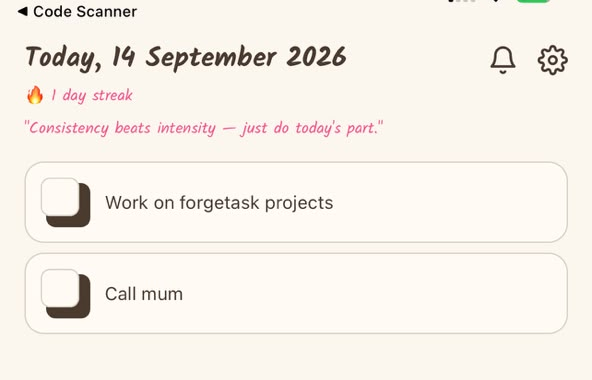
The visual identity went through three real stages before landing anywhere close to final. It started as a pixel-art style, tested directly in the running app and dropped once it didn't hold up in real use. That was replaced with a softer, hand-drawn sketch style in a pink and coral palette. That version shipped and ran for a period, but read as too narrow for the audience the product needed to reach, which is what led to the deep green identity it launched with.
Stage one: an early pixel-art exploration, tested in the real app and dropped after use.Stage two: the hand-drawn sketch style in its original pink and coral palette.Stage three: the same sketch style, rebuilt around the final green identity.The finished green direction, carried through onboarding and every other screen.
05User flow
The actual navigation loop:
Onboarding
Sign up / Log in
Set a weekly goal
Add a linked daily task
Complete the task
Goal progress updates
Streak & Progress log
back to Weekly
Invite a friend
Tag them into a shared goal
They accept
Combined progress, live
06User journey: from first open to a habit forming
Stage
First open
Set the first goal
First real week
Bring in a friend
Doing
Reads onboarding, signs up
Sets a weekly goal, adds a task
Checks tasks off daily
Sends or accepts an invite
Feeling
Curious, slightly skeptical
Uncertain whether it's worth setting up properly
Motivated if the streak holds, discouraged if a day slips
More accountable once someone else can see it
Risk
Onboarding overstays its welcome
Goal feels disconnected from daily tasks
One missed day feels like failure, so she quits
Inviting feels like extra work with no clear payoff
What ForgeTask does
Four short slides, never shown again once dismissed
Task creation links directly to the goal by design
Streak reflects real days, and a daily nudge catches a slipping day before it's lost
One-tap invite link, shared goals and nudges built in from day one
07Wireframes: mid-fidelity structure
Weekly screen
Top bar
Quote card
Goal progress bar
Two lines of stat text
Goal card
Goal card
"+ Add goal" button
Today screen
Top bar
Line of stat text
Task row (checkbox)
Task row (checkbox)
Task row (checkbox)
"+ Add task" button
Friends screen
Top bar
Friend card
Line of stat text
"Cheer" button
"Nudge" button
Shared goal card
08Challenges: the App Store detour that led to a better answer
ForgeTask was originally meant to launch as a native app on the App Store and Play Store. That was the plan from the start. It didn't survive contact with reality.
The plan: native, on both stores.Built from the beginning on Expo, targeting a real App Store and Play Store release like any standard mobile app.
The blocker: real costs, no budget.Google Play's one-time fee, Apple's $99/year developer program, and a further cost for an alternative store option. None of it was money available for this project.
What got ruled out.Sideloading an Android APK directly was possible but free only for Android, with no equivalent path for iPhone without a paid Apple account and a Mac to sign it.
The pivot: ship as a PWA instead.Same codebase, deployed to the web and made properly installable (home-screen icon, standalone display, working offline-friendly caching) with no store, no fee, and no review wait.
The same constraint, again, for sign-in.Apple Sign-In needed the same paid developer account. Rather than block launch on it, it was dropped for now, and Google sign-in shipped instead.
The PWA path wasn't the first choice, it was what was left once the store fees weren't an option. It turned out to remove real friction a store listing would have added anyway: no review wait, no fee, and every fix reaches users the moment it's pushed.
09Iterating through real use
The build ran in tight loops: specify a feature or correction, direct the AI agent through implementation, have it verify its own work, then test the result myself before it ever shipped. Nothing was "finished" on a code diff alone. Several rounds went back for correction after real testing surfaced something the first version missed.
I don't have an exact count of sprints or individual pushes across the build to report here honestly. This ran as many rounds over several weeks rather than a fixed number I tracked. The one precise number I can stand behind: 24 separate database migrations, each a real, reasoned schema or security change, not a placeholder.
10Testing against real devices, not a lab
There was no formal moderated study behind this. Testing meant real devices, real accounts, and deliberately trying to break the parts most likely to be wrong, especially anything touching more than one person's data. That process is what actually caught the issues that mattered:
A database security gapa shared goal's progress could be silently corrupted by a user who was never entitled to contribute to it. Found and closed through a deliberate, repeated security audit process, not by chance.
A Google sign-in flow that hung forevera popup silently blocked by the browser left the button spinning with no error at all. Traced to the exact line causing it and fixed with a real timeout and fallback.
A stale invite code misrouting a new signuptraced through real reproduction, not guesswork, to a leftover value never being cleared after use.
11Design system
A small, consistent system carries the whole product: a warm cream background, a deep forest green as the primary brand color with a brighter green for accents and icons, a hand-lettered display font, and a tactile, neubrutalist press effect on every interactive element (buttons, checkboxes, cards), so the whole interface feels like something physical rather than flat.
The wordmark itself went through its own small revision: "Task" originally used the darkest green in the palette and was hard to read at small sizes, so it was switched to the brighter accent green instead, a direct result of checking it against a real screen, not just a design file.
12Final design
The finished product, live now as an installable PWA: no App Store, no fee, updating instantly on every release.
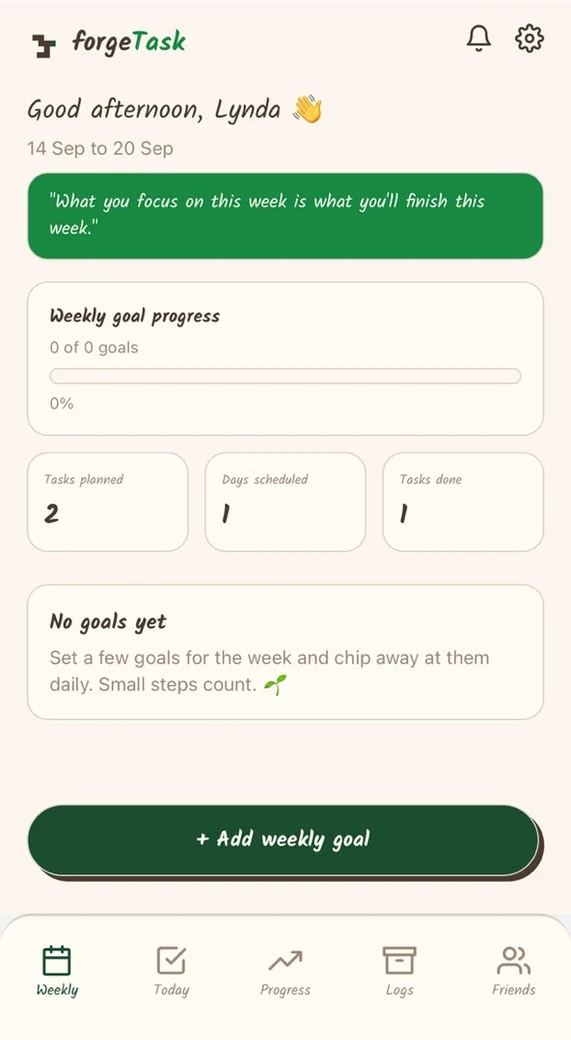
The Weekly screen
Goal progress, a daily-planning snapshot, and a rotating motivational line, all built around the plan-then-do loop the whole product is organized around.
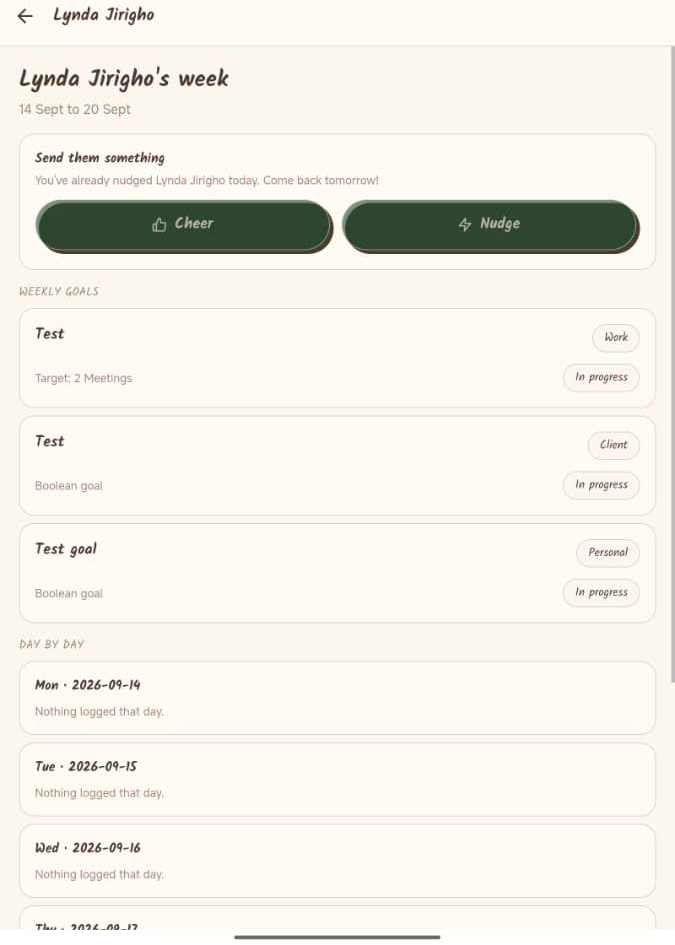
Friends & shared goals
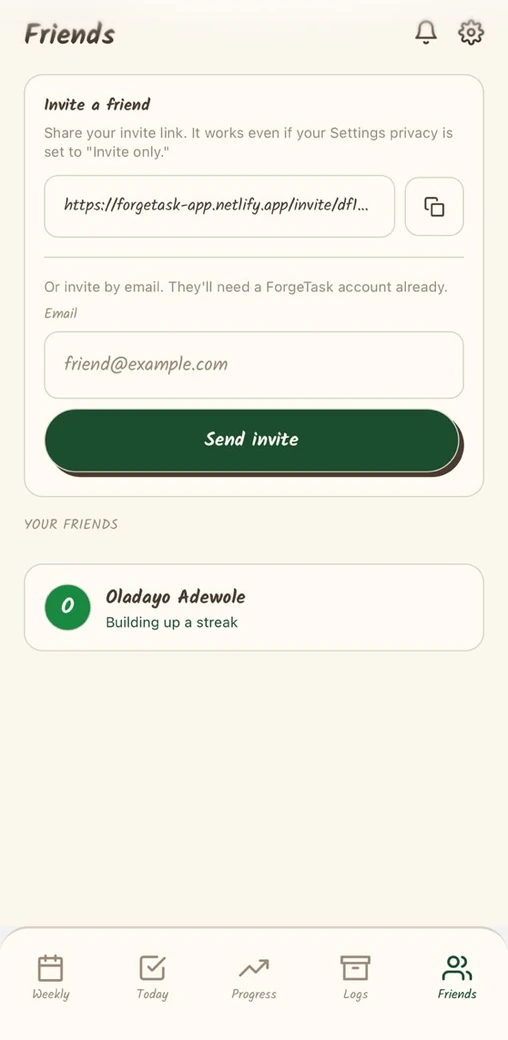
A friend's week, shared and personal goals side by side, and the Cheer / Nudge buttons that carry the product's accountability layer.
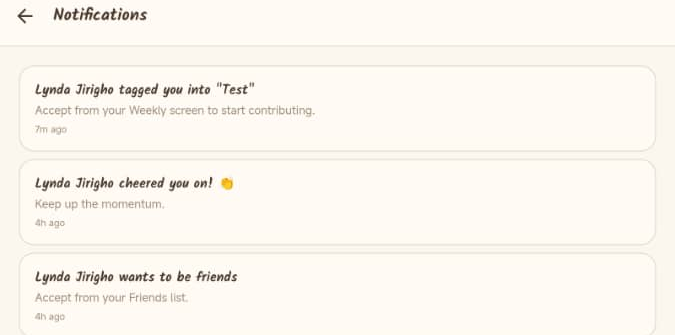
Real-time notifications
Shared-goal invites, cheers, and friend requests, delivered live the moment they happen, not on a refresh.
13What I learned
Verification discipline beats confidence.Several real bugs would have shipped invisibly if "the code compiles and looks right" had been the bar. It wasn't. Reproducing the problem for real was.
A budget constraint produced a better decision.The PWA path wasn't the first instinct. It turned out to be the right call anyway: no review process, no fee, instant updates.
A security audit should be routine, not a one-time event.The most serious issue in this build was caught because auditing happened again as new features were added, not just once at the start.
Directing an AI agent is still a design job.Every spec, every correction, every judgment call about what "done" actually means still had to come from me. The agent built fast, but it didn't decide what was right.
14Where it stands today
ForgeTask is live and still early. The real outcome right now is what got built and held up under real testing, not a usage metric yet.
20real users trying ForgeTask right now
24database migrations, each a real, reasoned schema or security change
6scheduled and user-invoked backend functions
0App Store fees paid, PWA install instead
3real production bugs found and closed through deliberate re-testing, not luck
The best product outcomes here came from testing against real use, not trusting that finished-looking code meant a finished feature.
More screens
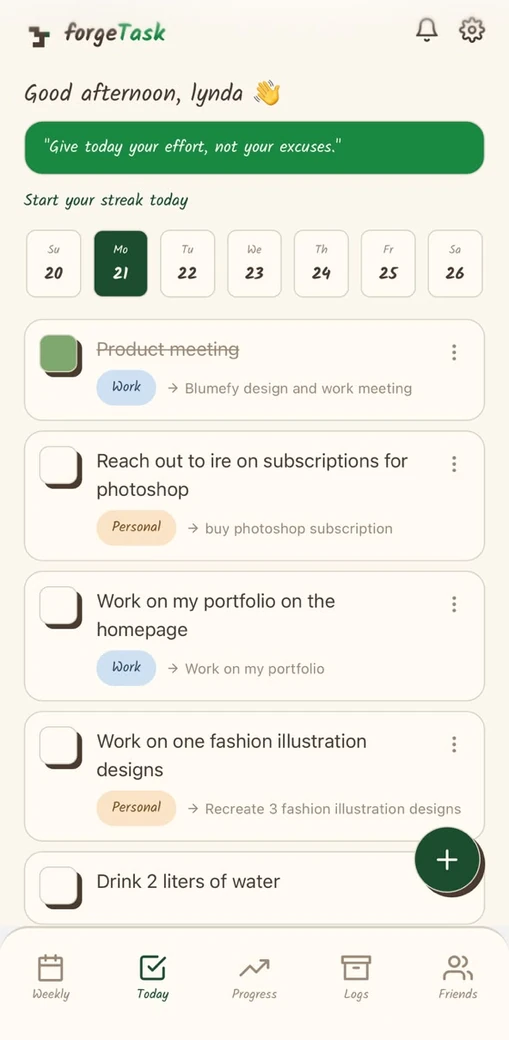
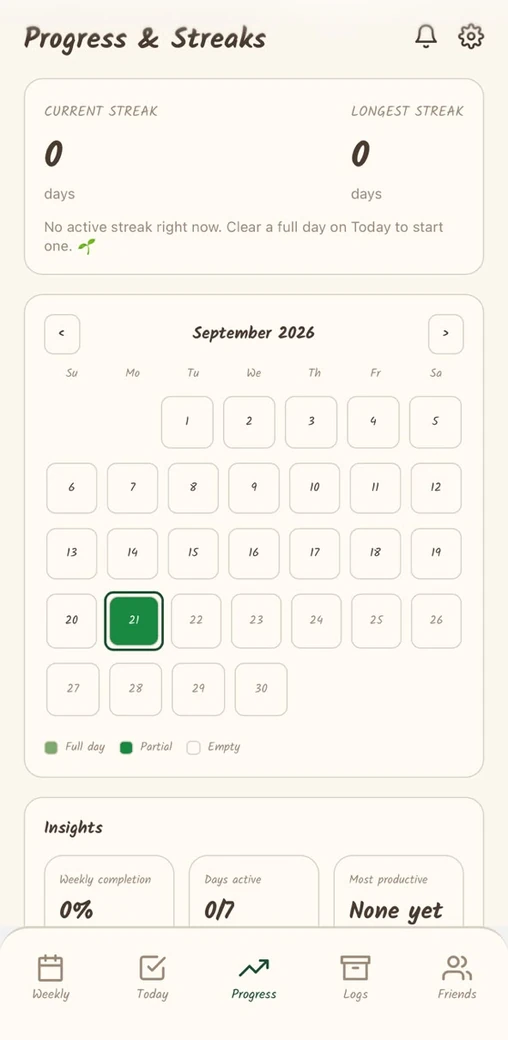
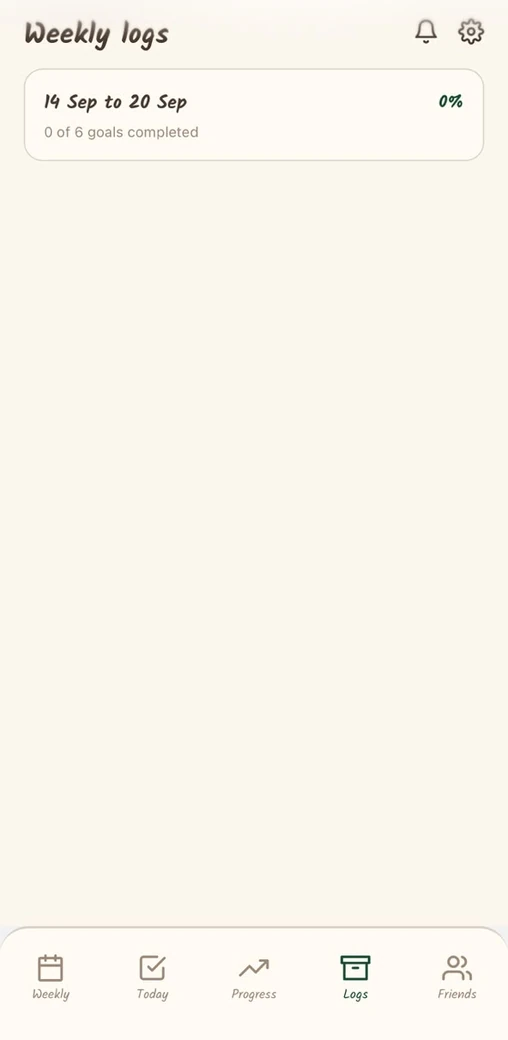
Today: each task shows the weekly goal it feeds.Progress & streaks: current streak, calendar heat, and weekly insights.Weekly logs: completed weeks kept as a record.Friends: invite by link or email, privacy setting respected.